What Californians Should Eat and Take This Week While Smoke Rolls Back In
Staff Writer
Five weeks after it started, the Timber Fire was still only 39 percent contained. It ignited on the evening of August 8, 2026 southeast of Loma Vista in the Los Padres National Forest, and by September 13 it had taken 25,426 acres of the Ventana Wilderness, terrain so steep and remote that crews were still working isolated heat sources and reinforcing containment line by hand, according to CAL FIRE's incident page. The Plaskett Fire, which started August 26 nearby, added another 29,862 acres to the same column of smoke.
That smoke does not stay in Monterey County. On August 31 the Bay Area Air Quality Management District issued an advisory through September 1 for exactly this smoke, telling residents to keep windows and doors shut and to run their car ventilation on recirculate. The district declined to call a Spare the Air Alert, noting that pollutant levels "are not expected to exceed the national 24-hour health standard." It was at least the second such advisory in a month.
Which is the situation most of us are actually living in. Not a red sky day, not ash on the windshield, but a long gray stretch where the air is somewhat worse than it should be, for weeks, and the question of what to do about it has no dramatic answer.
Into that gap walks the wellness industry, and it has a lot to say about antioxidants. Some of it is supported. Most of the specific claims are not. Here is the honest version: diet is a slow, cumulative hedge against a mechanism we understand well, and it does not substitute for the three things that change how much smoke enters your body this week, which are a filter, a closed window and a mask.
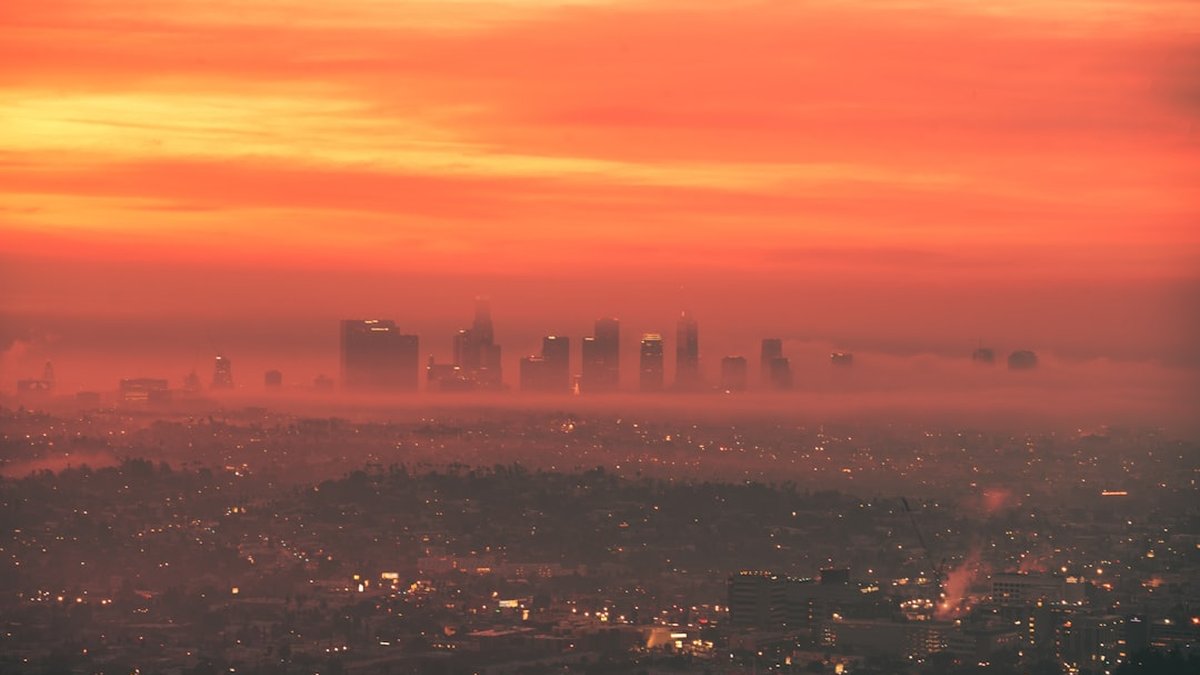
The California Air Resources Board describes wildfire smoke as "a complex mixture of air pollutants," and the part that matters most is PM2.5: particles fine enough to reach deep into the lungs and, CARB notes, to pass into the bloodstream.
Once there, they generate reactive oxygen species. A clinical review in Cureus archived on the NIH's PubMed Central lays out what those do: they disrupt the airway's epithelial barrier, make it more permeable, impair the mucociliary escalator that normally sweeps debris out of your lungs, and kill lung cells outright. Think of the airway lining as grout between tiles. Oxidative stress dissolves the grout.
That same review makes clear that wildfire particulate is not ordinary city particulate. Pediatric respiratory emergency visits rose 30 percent per 10-unit increase in wildfire-specific PM2.5, against 3.7 percent for the same increase from non-wildfire sources, roughly an eightfold difference in harm to children.
The strongest evidence that food changes anything here comes from an odd place: the 2014 Hazelwood coal mine fire in Victoria, Australia, which blanketed the town of Morwell in smoke for weeks. Eight and a half years later, researchers compared 282 Morwell residents against 166 people from unexposed Sale nearby and asked whether diet had mattered.
It had, modestly and specifically. Among people meeting recommended intakes, vitamins A and E, magnesium and zinc weakened the link between exposure and chronic cough. Vitamins A and E and zinc, though not magnesium, weakened the link to chronic phlegm. Omega-3 fatty acids weakened the link to COPD. The authors concluded that "higher-quality diets may reduce harms due to smoke exposure from landscape fires."
Note what that is and is not. It is a cross-sectional look at ordinary dietary adequacy over years, not a trial of pills taken during a smoke event. Nobody has shown that eating a carrot on a bad AQI day does anything by Thursday.
Oregon State University Extension publishes Food to Fight Wildfires, the most practical public guide on this, and its advice is unglamorous: vitamin A and carotenoids, vitamin E, vitamin C, omega-3s, with colorful fruits and vegetables named as the richest sources. It also flags iron, calcium and zinc as helping limit the body's absorption of heavy metals released by fire, an angle that gets almost no attention.
September in this state makes that easy. Central Valley stone fruit and melons are still running, Brentwood and Capay peppers are at peak carotenoid, almonds and walnuts cover vitamin E, and Monterey Bay's own fishery supplies the omega-3s. Citrus arrives in a few months. None of this requires a supplement aisle.
On quercetin, cruciferous vegetables and glutathione precursors, and on N-acetylcysteine, the picture is thinner than the internet suggests. The official guidance I can find does not evaluate them, and the Hazelwood study did not test them. Absence of evidence, not evidence of absence, but worth knowing before you spend.
Vitamin A, carotenoids and vitamin C came out of the Hazelwood analysis as the nutrients that softened chronic cough and phlegm.
The only nutrient in that study linked to a lower COPD association with extreme PM2.5 exposure.
OSU Extension cites these for reducing absorption of heavy metals released during fires.
The measured benefit came from meeting recommended intakes over years, not from loading up during a smoke week.
Since the 2017 wine country fires, glutathione has circulated among Western wildland firefighters, given by IV drip or nebulizer in tents at incident briefings, expanding through the January 2025 Los Angeles fires and the Spokane fires of August 2026. The biological logic is the same one above. The execution has been a mess.
In August 2026, at least two compounding pharmacies recalled glutathione batches after lab testing found bacterial contamination, one of them a nationwide recall out of Austin after elevated endotoxin levels; firefighters reported fever, chills and severe headaches, the Associated Press reported. The International Association of Fire Fighters, representing about 360,000 first responders, issued a safety advisory. Nebulized glutathione can constrict airways in people with asthma or chronic lung disease, which is to say it can do the opposite of what it promises to the people most likely to want it.
We lack clinical evidence of its efficacy.
It is worth saying plainly that neither CARB's Smoke Ready California program nor the EPA's 2026 factsheet catalog, updated September 1, 2026 and built with CDC, CARB, California OEHHA and the Forest Service, lists nutrition or supplements as a topic at all. Their entire recommendation set is about keeping particles out of you.
The numbers explain why. HEPA filtration cuts indoor PM2.5 by 54 to 92 percent. MERV 12 and higher HVAC filtration reaches up to 87 percent. A properly fitted N95 filters up to 94 percent of particles in single-pass testing. No food does anything remotely comparable.
CARB's practical version: check your AQI, keep windows and doors closed, install MERV 13 or better filters, run a CARB-certified air cleaner, and designate one filtered room as a Cleaner Air Space. BAAQMD adds a piece people forget, which is to skip the wood fire, the leaf blower, the mower and the barbecue while smoke is in the air, because you are adding to the particulate load in the exact place you sleep.
Research presented to CARB on September 1 by University of California, Irvine scientists looked precisely at this pattern, repeated short-term exposure rather than one catastrophic week, and found that severity tracked both intensity and duration, and that people with fewer resources absorbed more of it. That is the Timber Fire's real signature. Thirty-nine percent contained after five weeks, crews still on the ridgelines, a fire that will not produce a single memorable day of orange sky and will instead deliver six weeks of air that is slightly wrong.
Against that, a box fan with a filter taped to it and a shut window do more than anything on a supplement shelf. The plate still matters. It just matters the way plates do, over seasons, which in California happens to be the same timescale as the fires.
Comments
No comments yet. Be the first to comment!
Leave a Comment